
Copied!
Story apps Take your next step in the Story Shack suite.
 Saved ideas
 See previous results (<% accordionPreviousResults.length %>)
Copied!
Explore Story Shack
More generators, writing tools and storytelling resources.
Explore more from Writing Prompts
- Pictionary words
- Objects
- Writing prompts
- Topics
- Monologue ideas
- Fanfic AU prompts
- Dream prompts
- Trans Joy Story
- Imaginary Friend
- Disaster Movie Setup Name
- Twin Story
- Bubble App Ideas
- Childhood memory prompts
- Family Motto
- Cold War Setting
- Bronze Age Setting Prompts
- Outfit aesthetic prompts
- Death Scene Prompts
- Chapter Title Prompts
- Disease names
- Babysitter Horror
- Evil organizations
- Coming of Age Beats
- Morning Pages
- Ancestor Altar Themes
- Prophecy prompts
- Magic Class Schedule Prompts
- Bedtime Story Hooks
- Breakup Prompts
- Diplomatic Incident Prompts
- Eulogy Openers
- Riddle prompts
- Bachelor Mansion Contestant
- Treasure Map Clue Brief
- Funeral Scene Prompt Brief Generator
- Magic system prompts
- Royal court scene prompts
- Battle Scene Brief
- Excuse To Skip Meeting
Discover even more random name generators
Explore all Writing
Skip list of categories







What the generator gives you
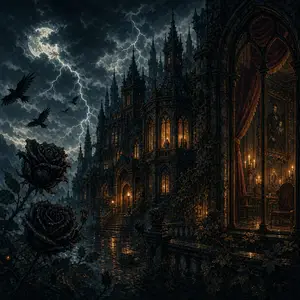
Every prompt in this set is one complete scene, written in a single sentence, anchored by a gothic-heroine motif. Each one names a heroine already on the edge of doing something: she has been told a thing that is not true, she has found an object that should not be where she found it, she has heard a sound that should not have come from the room she is standing in. The output is a scene prompt, not a name, not a title, not a sentence-to-finish. The phrasing leaves you with a specific doorway to walk your heroine through, and the rest of the page is yours.
Origins and the conventions of the form
The gothic heroine of the late eighteenth and nineteenth centuries arrived with a recognizable set of conditions. She was usually an orphan or a ward. She was usually poor in a way that mattered legally, even when she lived in rooms the size of cathedrals. The house she entered was older than the family that owned it, and at least one room in the house had been sealed before she was born. The man who seemed to want her tended to want something else, and the woman she was meant to trust turned out to be the keeper of the worst fact in the house. These conventions were never random. They were the form's way of putting a young woman alone inside a structure that did not love her, and then asking what she would do when the structure started to move.
The prompts in this generator lean on those conventions without copying any specific book. A ward arrives at an estate she has not been told about. A locket contains a portrait of a woman the family will not name. A suitor offers the key to a forbidden wing in exchange for a promise she cannot make. A stranger in the cellar is wearing the heir's coat. The motifs are arranged so that you can use the same heroine across several prompts, or build a cast of women who each carry one thread of the same secret. The point is not to recreate a specific novel; the point is to give you the room to write your own.
How to use a prompt in your draft
Pick the prompt that already feels like the first line of something you want to write. Read it once to find the verb the heroine is about to commit, then read it again to find the person or object the family does not want her to notice. That is your scene. Open with the prompt as the inciting image, then write the next sixty seconds from inside her head. The generator has done the work of putting the right props on stage; you do the work of deciding what she does about them.
Several prompts can be combined into a single arc. A parentage-mystery prompt becomes more interesting when the locket in the same chapter is engraved with a date the family will not explain. A suitor who has been lingering on the staircase becomes more dangerous when the cellar door is open the next morning. Stack two or three prompts the way the form always stacked them, and the heroine stops being a person visiting a house and starts being a person whose presence is rearranging the house.
Picking the heroine's voice
The prompts are written in a third-person voice, but they are written about a woman, and they leave her interiority to you. Decide, before you start the scene, how much she knows. Some heroines walk in already suspicious. Others walk in hopeful, and the first sentence of your scene is the moment they stop being hopeful. A few walk in knowing exactly what is in the cellar, and the prompt is the surface they are presenting to the family. The prompt is the same in all three cases; what changes is who she is when the sentence lands.
Identity, inheritance, and what the form was actually about
The gothic heroine is not only a mood. She is a question about who gets to inherit a house, who gets to inherit a name, and what a young woman is supposed to do when the documents do not match the portrait. A surprising number of these prompts are really about paperwork: a christening entry in the wrong hand, a will that names her as heir to a sum that was paid in a coin the family no longer uses, a deed of the cellar drawn by a hand that did not draw the house. The gothic is at its sharpest when the danger is not a man in the corridor but a question in the registry, and the generator leans into that.
When you take a prompt into your own draft, decide which thread the inheritance plot is going to pull. A will that names her can mean she is owed money. It can mean she is owed a name. It can mean the family would rather she not exist at all. The same sentence carries all three readings, and the difference is what she chooses to do in the next paragraph.
Tips for writing the scene that follows the prompt
- Open on the prop the prompt just put in her hand. The locket, the letter, the cellar key, the suitor's glove. The reader needs to see the object before they need to see her reaction to it.
- Let the household notice her before she notices the household. A housekeeper who uses the wrong name, a dog that takes bread from the wrong person, a maid who curtseys in the dark. The house has information about her that she does not yet have about herself.
- Use the weather. Rain that will not stop, fog that has lifted from the village but not the lane, a storm that arrives the night she does. The gothic form uses weather as plot, and so should you.
- Do not let her speak in the first scene. Let her answer. Speech comes later, when the house has earned it.
- End the first scene on the second floor. The ground floor is for arriving. The second floor is where the sealed room is.
Inspiration prompts to keep beside this generator
- Write the scene from the housekeeper's point of view the morning the heroine is expected, and let the housekeeper be the one who is afraid.
- Pick three prompts at random and ask which character appears in all three. That character is the one the book is actually about.
- Take a prompt you do not want to use and ask what is wrong with it. The answer is usually a verb, and the verb tells you what your heroine is refusing to do.
- Write the prompt from the suitor's side, and let the suitor know less than the reader does.
- After two scenes, hand the prompts to a friend and ask which one they would write next. Their answer is your third scene.
Frequently asked questions
How does the Gothic Heroine Generator work?
The generator surfaces a curated pool of scene prompts built around the conventions of the gothic-heroine form. Each click returns a single complete scene in a single sentence, anchored by a specific motif such as a parentage mystery, a locket, a sealed east wing, a dangerous suitor, or the door in the cellar. You can re-roll freely until a prompt fits the scene you want to write.
Can I steer the Gothic Heroine Generator toward a specific name angle?
The generator is built around scene prompts rather than character names, so the steering happens by re-rolling until a motif fits your heroine. If you want a parentage-led scene, keep re-rolling until a prompt opens on a ward, a register, or a christening gift. You can also stack two or three results to build a single arc across one chapter.
Are the names original and safe to use?
The prompts in this generator were written for this set and are free to use in personal and most commercial writing projects, including novels, short stories, serialized fiction, tabletop campaigns, and game narrative. The motifs draw on a long public tradition, so credit the form rather than the generator if a prompt helps you build a major plot element.
How many names can I generate?
You can re-roll as many times as you like. Each click returns a fresh single-sentence scene prompt, and the pool is broad enough to support long drafting sessions without obvious repetition. Save the ones you like and combine them into longer arcs as you draft.
How do I save the names I like?
Use the click-to-copy button on any prompt you want to keep, or tap the heart icon to save it to your favorites list. Saved prompts stay accessible across sessions, which is useful when you are building a chapter out of three or four stacked scenes.
What are good Gothic Heroine?
There's thousands of random Gothic Heroine in this generator. Here are some samples to start:
- A ward in her uncle's house for as long as the elm grew over the chapel wall, and the midwife who brought her in is found drowned in the mill race with a brass button in her hand.
- The locket that falls from the gutted chair in the attic opens onto a portrait of her mother wearing a key around her throat, and a date scratched into the gold that names a wedding the family never speaks of.
- A room with a fire lit from the left is one she cannot enter and has not been able to since the night she watched her mother walk into the embers and smile.
- The heir to the entailed estate is in no hurry to leave the house where she is only a guest, and he keeps his hat on in the parlour as though the place already answers to him.
- Behind the cellar door that the housekeeper never opens, a second stair climbs upward into a corridor no one has walked since the year the east wing was sealed.
- The name written on the travelling case is the one she answers to but the letter that brought her was written in a hand she has not seen since her mother died and a hand her mother could not write.
- The carriage turns through the gate in weather that has not stopped since the village and the house is darker than the road she came down.
- Within the first hour she is told that the east wing is not her concern and that the door at the end of the gallery is not her concern either, and the dust on that door is fresh.
- The letter from her late aunt arrives by a courier who does not wait for an answer, and the seal has already been broken and resealed with a different wax.
- The same room has been her dream three nights running and the room has no door and the window in it shows a garden she has not seen by day.
About the creator
All idea generators and writing tools on The Story Shack are carefully crafted by storyteller and developer Martin Hooijmans. During the day I work on tech solutions. In my free hours I love diving into stories, be it reading, writing, gaming, roleplaying, you name it, I probably enjoy it. The Story Shack is my way of giving back to the global storytelling community. It's a huge creative outlet where I love bringing my ideas to life. Thanks for coming by, and if you enjoyed this tool, make sure you check out a few more!
Embed on your website
To embed this idea generator on your website, copy and paste the following code where you want the widget to appear:
<div id="story-shack-widget"></div>
<script src="https://widget.thestoryshack.com/embed.js"></script>
<script>
  new StoryShackWidget('#story-shack-widget', {
    generatorId: 'gothic-heroine-name-generator',
    generatorName: 'Gothic Heroine Generator',
    generatorUrl: 'https://thestoryshack.com/tools/gothic-heroine-name-generator/',
    language: 'en'
  });
</script>