
 Saved ideas
 Explore Story Shack
More generators, writing tools and storytelling resources.
Explore more from Writing Prompts
- Topics
- Objects
- Writing prompts
- Pictionary words
- Fanfic AU prompts
- Monologue ideas
- Dream prompts
- Morning Pages
- Moral dilemma prompts
- Blessing Generator
- Childhood memory prompts
- Coup Attempt Names
- AI image aesthetic ideas
- Auto Reply Snark Briefs
- Crystal Ball Vision Prompt
- Prophecy prompts
- Standup Excuse Prompt Generator
- Achillean Roommates Tropes
- Camp Counselor Story
- Tombstone Epitaph Brief Generator
- Therapy Journal Prompts
- Coming of Age Beats
- Battle Cry Generator
- Disaster Movie Setup Name
- Hireling Prompts
- Conspiracy Theory Hook Generator
- Trans Joy Story
- Diplomatic Incident Prompts
- Cold War Setting
- Found Treasure Prompt Generator
- Abandoned Lab Prompts
- Chase Scene Prompts
- Cartoon Show Pitch Concept Generator
- Cover Identity
- Outfit aesthetic prompts
- Antagonist Motive Prompts
- Shipping prompts
- Black Mirror Episode Name Generator
- Body Horror Affliction
Discover even more random name generators
Explore all Writing
Skip list of categories



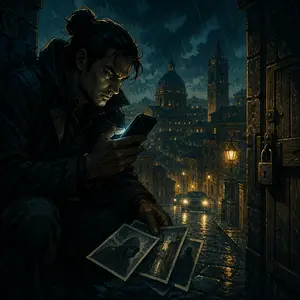



What a letter prompt is for
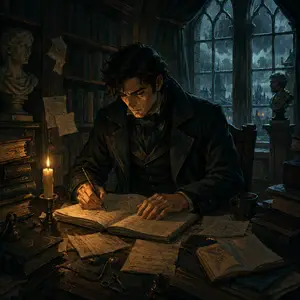
Letters are one of the oldest devices in fiction and one of the most efficient ways to put a voice on the page. A letter is a character, a moment, and a relationship, all folded into a single envelope. When you can pin down who is writing, who is reading, and what is being left unsaid, the rest of the page is mostly work. Most of the time the hardest part of writing a letter is not the prose. It is the moment of sitting down without yet knowing who the letter is from. A good letter prompt gives you that person, that addressee, and the one sentence the letter cannot quite get around.
This generator is built for that moment of sitting down. Each prompt is a short brief rather than a finished idea. The sender has an occupation and a history. The recipient is named by relationship rather than by name, so you can fill the name in yourself. The time and place of the writing are suggested. The hidden subject of the letter is implied rather than stated. From those four anchors, the rest of the letter tends to write itself.
How the prompts are organized
The collection is grouped into twenty topical lenses, each one a different way of cutting into the form. Some lenses focus on the sender, the person at the writing desk: a soldier, a widow, a midwife, a teenage runaway, a choir director, a former political prisoner. Others focus on the relationship between sender and recipient: estranged siblings, a parent and an adult child who has cut off contact, a patient and a former therapist, an ex-wife's new husband. Other lenses focus on the secret the letter is keeping, the subtext that runs beneath the visible text, the date and place at the top of the page, or the reason the letter is being written at this particular moment.
Other lenses turn on a single object enclosed in the envelope, on a tone that wavers between composure and panic, on a memory the writer is no longer sure of, on an apology that circles the actual harm, on a confession that takes three pages to arrive, on a coded message meant to pass a censor, on a letter that is drafted and never sent, on a postscript that carries the real news, on a detail in the handwriting, on the imagined reply, on the gap between formal and intimate address, on the date that anchors the letter in a specific year, and on the final sentence the writer has been holding for the whole letter.
Because the lenses are designed as topic slices, two prompts will rarely feel like the same exercise. You might use a sender identity brief on Monday, a confession-delayed brief on Wednesday, and a postscript-turn brief on Sunday. The variety is intentional, and re-rolling is part of the tool.
How to use this generator
There is no wrong way to use a letter prompt, but a few small habits tend to make the drafts feel quicker to write.
Pick the strongest single sentence, not the most useful one
The prompt that surprises you is almost always the prompt that will give you the best letter. Re-roll past the ones that feel too on-the-nose or too neat. The right brief is the one that gives you a slight chill of recognition when you read it. If you find yourself thinking, oh, that is exactly the letter I have been trying to write, you are probably looking at the right one.
Decide the historical moment before the prose
Many of the briefs suggest a year, but most leave it to you. Pick a date before you write a word. The year of the letter decides the envelope, the ink, the transport, the postal rate if it matters, the slang, the way the writer addresses the recipient, and the news items the writer can plausibly know about. A letter dated 1944 sounds nothing like a letter dated 2024 even when the same person is writing both.
Let the sender keep one secret from the recipient
Every brief already names the secret the letter is keeping. The temptation is to explain the secret in the body of the letter. Resist. The interesting letter is the one where the reader can feel the secret under the text without the writer ever naming it. Trust the prompt to do the work of pointing at the gap. Trust yourself to leave the gap.
Use the object enclosed, if the brief gives one
The object-enclosed lens is one of the easiest to write from. A pressed leaf, a key, a single chess piece, a recipe card, a hotel keycard, a ticket stub. The object is a small piece of the writer's life that the letter hands to the reader. Describe it in one or two sentences at the end of the letter, the way a real letter would. The object does the emotional work the prose is trying not to do.
Use the final sentence as a target, not a constraint
Many of the briefs end with a final-sentence prompt. Treat the final sentence as the line the whole letter is moving toward. The body of the letter is the writer trying to get to that sentence without losing the nerve. If you cannot find the right final sentence, re-roll. There is a letter inside you that knows exactly how it wants to end.
What kind of writer this generator is for
The briefs are written for fiction writers, memoirists, and screenwriters, but they have been tested by letter writers to living friends, by pen-pal hobbyists, by parents writing for their children, and by people who want to draft a letter they will probably never send. The lens that holds the most weight for non-fiction writing is the letter-never-sent lens. Pick that one and write the letter you have been composing in your head for the last three years. You do not have to send it for the writing to count.
If you are a teacher running a class on epistolary fiction, the historic-and-modern-mode lens is the most useful. Pick two prompts, one from the early twentieth century and one from the present, and ask the class to draft the two letters in the same hour. The contrast is the lesson. If you are a hobbyist writing a letter to a real person, the sender-identity and recipient-distance lenses are the place to start. Pick a brief that resembles your actual situation but not too closely, and let the small differences do the work of opening up the prose.
Tips for getting more out of each brief
Once you have chosen a prompt, a few small moves tend to make the draft feel more like a letter and less like a scene in a novel.
Open with the address, the date, and the time of day. A real letter starts with something like, My dear Sarah, Vineyard Haven, the second Tuesday of June, just after breakfast. The address and the date do half the work of putting the writer in the room.
Let the prose catch the weather, the season, and the room. Letters in fiction often fail because the room is missing. The writer is in some specific kitchen, on some specific porch, at some specific hour of the day. A line about the kettle, the rain on the window, or the way the writer's hand feels on the page will do more for the reader than a paragraph of emotion.
End with a small human gesture, not a thought. The most reliable letter endings are physical. The writer signs, blots the ink, folds the paper, looks out the window, walks to the post box, or realizes she has sealed the letter before adding the postscript. A small gesture at the end is worth a paragraph of reflection in the body.
Use the recipient's name sparingly. If the recipient is named in the salutation, the name does not need to appear again for several paragraphs. The name works harder when it shows up again at the end, in the sign-off, or in a single sentence in the middle that the writer has been saving.
Read the letter aloud before you finish it. A letter is the closest a piece of prose gets to speech. If a sentence sounds stiff when you read it out loud, it is probably a sentence the writer would not actually use in a letter. Trust the voice. Trust the cadence. Trust the breath at the comma.
Inspiration prompts to start with
If you are not sure which lens to begin with, the briefs below are a soft on-ramp. Each one is also present in the generator, so you can re-roll into a related angle whenever you want more.
A letter from a soldier on the eve of a deployment he has not told his mother about
A letter from a son to a mother in a care home who no longer remembers his name
A letter that conceals a suicide attempt behind an anecdote about the kitchen faucet
An invitation to visit that is actually a goodbye the writer cannot say out loud
A letter dated from a parking lot outside a funeral home, an hour before the service
A letter because the writer's mother died last week and the writer is not sure who to tell first
A letter that encloses a key that no longer fits the lock it was cut for
A letter that begins Dear Sir and within three lines has dropped the salutation entirely
A letter in which the writer is not sure she ever lived in the house she is describing
An apology whose real subject is the writer's fear of losing the recipient, not the wrong itself
How does the Letter Prompt Generator work?
Each click surfaces a single short letter-writing brief from a curated set built around the form of the personal letter, randomized so the same prompt does not appear twice in a row. The aim is to give you a starting point concrete enough to sit down and write a letter from immediately, with a sender, a recipient, a moment, and a hidden subject already in place.
Can I steer the Letter Prompt Generator toward a specific prompt angle?
You cannot pin a single lens, but you can re-roll until the angle you want shows up. A practical habit is to keep re-rolling until a brief lands, then write the letter that fits it. If you want a more sustained angle, work through the same lens for a week and notice how the same anchor produces very different letters when the sender and the recipient change.
Are the prompts original and safe to use?
Every brief in this generator was written for this tool and is free to use in personal letters, fiction, memoir, scripts, and most creative or commercial contexts. Nothing here reproduces a real person, a real letter, or a real private correspondence. The prompts are deliberately abstract enough to remain the writer's own.
How many prompts can I generate?
You can re-roll as many times as you like. The generator is designed to be used freely across a long project, so feel free to come back whenever the next letter is not yet obvious. If you find yourself returning to the same lens, treat that as useful information about the kind of letter you are trying to learn to write.
How do I save the prompts I like?
Click the heart or save icon next to any brief to add it to your personal collection for later. You can also copy a brief to your clipboard with the click-to-copy control and paste it directly into your notebook, your notes app, or the top of the document you keep open while you draft. The most useful habit is to save the briefs that surprise you on a re-read.
What are good Letter Prompts?
There's thousands of random Letter Prompts in this generator. Here are some samples to start:
- A letter from a soldier on the eve of a deployment he has not told his mother about
- A letter from a son to a mother in a care home who no longer remembers his name
- A letter that conceals a suicide attempt behind an anecdote about the kitchen faucet
- An invitation to visit that is actually a goodbye the writer cannot say out loud
- A letter dated from a parking lot outside a funeral home, an hour before the service
- A letter because the writer's mother died last week and the writer is not sure who to tell first
- A letter that encloses a key that no longer fits the lock it was cut for
- A letter that begins Dear Sir and within three lines has dropped the salutation entirely
- A letter in which the writer is not sure she ever lived in the house she is describing
- An apology whose real subject is the writer's fear of losing the recipient, not the wrong itself
About the creator
All idea generators and writing tools on The Story Shack are carefully crafted by storyteller and developer Martin Hooijmans. During the day I work on tech solutions. In my free hours I love diving into stories, be it reading, writing, gaming, roleplaying, you name it, I probably enjoy it. The Story Shack is my way of giving back to the global storytelling community. It's a huge creative outlet where I love bringing my ideas to life. Thanks for coming by, and if you enjoyed this tool, make sure you check out a few more!
Embed on your website
To embed this idea generator on your website, copy and paste the following code where you want the widget to appear:
<div id="story-shack-widget"></div>
<script src="https://widget.thestoryshack.com/embed.js"></script>
<script>
  new StoryShackWidget('#story-shack-widget', {
    generatorId: 'letter-prompt-generator',
    generatorName: 'Letter Prompt Generator',
    generatorUrl: 'https://thestoryshack.com/tools/letter-prompt-generator/',
    language: 'en'
  });
</script>