
 Saved ideas
 Explore Story Shack
More generators, writing tools and storytelling resources.
Explore more from Writing Prompts
- Topics
- Objects
- Pictionary words
- Writing prompts
- Monologue ideas
- Dream prompts
- Fanfic AU prompts
- Phobia prompts
- Cover Identity
- Diary entry prompts
- Art Movement Manifesto Prompts
- Twin Story
- Gothic Family Secret Prompt Generator
- Prophecy prompts
- Citizen Science Project Briefs
- Adoption Story Generator
- Birthday Party Brief
- Diplomatic Incident Prompts
- Therapy Journal Prompts
- Animated Movie Pitch Names
- Obituary prompts
- Getaway Driver Generator
- Babysitter Horror
- Bubble App Ideas
- Found Treasure Prompt Generator
- Airport Scene Prompt
- Treasure Map Clue Brief
- Aromantic Story
- Chase Scene Prompts
- Body Horror Affliction
- Family Motto
- Betrayal Scene Prompts
- Adventures
- Kids' Book Series
- Trans Joy Story
- Cold War Setting
- Coming of Age Beats
- Battle Cry Generator
- Class Reunion Prompts
Discover even more random name generators
Explore all Writing
Skip list of categories



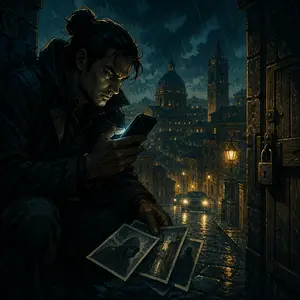

What is a conspiracy theory hook?
A conspiracy theory hook is the opening line a reader cannot put down. It lands inside an ordinary moment and tilts it: a diary entry that should not exist, a worker told never to mop a floor that is already dry, a road that ends at a fence drawn around a part of town no one can map. The line does not have to explain the conspiracy. It only has to make the reader feel that the explanation is one sentence away.
Why writers reach for conspiracy openings
Conspiracy hooks are useful at every stage of a draft. They break a slow first chapter by handing the narrator a tangible mystery on page one, reboot a stalled middle by reframing an ordinary scene as the seam where the cover-up begins, and give a finale its first move when the witness produces the photograph, the second will, the receipt that should not exist. The generator returns one finished sentence at a time, so you can drop the result into the manuscript as the first line of a scene, paste it into an outline, or roll until a hook points at the rest of the plot.
How the generator is built
The generator organizes the topic into twenty lenses, each a different angle a conspiracy hook can take. A few examples:
- Diary-entry hooks put the reader inside a first-person confession where a private journal starts to contradict itself.
- Turning-point hooks land on the exact moment a routine report stops being routine.
- Object-evidence hooks center a single physical clue: a child's drawing, a brass key, a photograph that should not exist.
- Long-timeline hooks trace a cover-up across decades, the way real cover-ups actually work.
- One-line-spark hooks compress the whole setup into a single short, sharp opener.
How to use the results
Treat each hook as a starting point, not a finished scene. Read the result, find the verb that carries the action, and ask what the narrator already knows. If the verb is found, what was the narrator looking for, and why was this object in that drawer? If the verb is was told, who told the narrator, and what did the narrator already suspect? A conspiracy hook earns its weight when the second sentence of your draft can answer one of those questions without resolving the larger mystery. Combine hooks the way you combine prompts: stack a diary-entry hook over a turning-point hook, or pair a workplace-coverup hook with a long-timeline hook, and the two lenses describe the same conspiracy from different rooms.
Choosing the right hook for your story
Match the lens to the chapter you are drafting. A flash-fiction piece wants the compression of a one-line spark or an object-evidence hook. A novel opening can carry a longer diary-entry or flashback-origin hook. Comic conspiracies lean on the dark-comedy lens, where a basement bunker has the same paint colour as the dentist's office. Noir registers lean on the liminal and confrontation lenses. When a hook almost works but slightly misses, keep the rhythm and swap the noun: a brass key becomes a brass button, a diary becomes a ledger, a cabin becomes a clinic.
Tips for stronger conspiracy openings
- Pick a single concrete object, instruction, or phrase, and let the rest of the sentence orbit it.
- End the hook on a small fact the narrator has not yet explained, not on a question the reader can answer in one word.
- Give the conspiracy a tell. Every cover-up in fiction has a single habit, and a strong hook shows that habit once.
- Keep the geography small. A conspiracy hook is sharper when the scene fits on a single street, a single desk, or a single page.
- Trust the verbs: found, was told, opened, slid, noticed, signed. The verb is the conspiracy.
- Do not resolve the mystery in the hook. Resolve one small thing, and the reader will follow you into the next paragraph.
Inspiration prompts to keep nearby
- Write the diary entry that the second diary entry corrects.
- Write the conversation that happens after the apology, when the apology is rewritten.
- Write the family photograph that nobody in the family will describe.
- Write the small object that was never supposed to leave the building.
Frequently asked questions
How does the Conspiracy Theory Hook Generator work?
The generator draws on a curated set of conspiracy-flavored opening lines, organized into lenses such as diary entries, workplace cover-ups, family secrets, and long-timeline arcs. Each click returns a single finished sentence.
Can I steer the Conspiracy Theory Hook Generator toward a specific name angle?
Yes. Re-roll until the result matches the mood you want, and combine two or three results. A diary-entry hook can open a chapter, a turning-point hook can break a slow middle, and an object-evidence hook can hand a witness the proof they need.
Are the names original and safe to use?
Every hook is written for this generator and is free to use in personal work and in most commercial projects. Treat the sentences as starting points, and rewrite any detail you want to keep, the way you would with any prompt.
How many names can I generate?
The generator is designed to be re-rolled freely, so there is no practical limit to how many hooks you can pull in a single session. The list behind the page is broad enough to support a full novel outline or a long campaign.
How do I save the names I like?
Use the heart icon next to any result to keep it in your saved list, and the copy button to drop the sentence straight into your draft. The saved list is stored on your device so you can return to your favourite hooks later.
What are good Conspiracy Theory Hook Generator?
There's thousands of random Conspiracy Theory Hook Generator in this generator. Here are some samples to start:
- I found another folded paper inside the library copy of my own birth certificate, and the librarian swears no one requested it today.
- When the stranger at the bus stop finally spoke, the question was, 'Did you ever find out who really ran the drill in seventy-one?' and the answer was supposed to be a name.
- The moment the inspector noticed the second shadow under the bridge was the moment the entire report stopped being a bridge inspection.
- By morning the radio had changed its tone, the weatherman smiled too easily, and the school bus took a route that had not existed the day before.
- My grandfather's funeral was attended by a man in a suit no one had ever seen, who placed a sealed envelope in the casket before the lid was closed and was gone before we turned around.
- The night shift supervisor told the new hire that the basement floor was never to be mopped, and the new hire noticed the floor was already dry.
- The road ended at a fence that had not been there the year before, and the fence ran in a perfect circle around the part of the town no one could draw on a map.
- The technician opened the casing and found a second antenna taped inside, running to a board that was not on any of the official schematics.
- They tried to bury it under a new name, a new logo, a new spokesperson, and a quiet press release timed for a holiday weekend, and the trouble was that the original paperwork was still in the safe.
- The basement bunker was enormous, well-stocked, and painted the exact same beige as the dentist's office two towns over, down to the framed picture of a sailboat.
About the creator
All idea generators and writing tools on The Story Shack are carefully crafted by storyteller and developer Martin Hooijmans. During the day I work on tech solutions. In my free hours I love diving into stories, be it reading, writing, gaming, roleplaying, you name it, I probably enjoy it. The Story Shack is my way of giving back to the global storytelling community. It's a huge creative outlet where I love bringing my ideas to life. Thanks for coming by, and if you enjoyed this tool, make sure you check out a few more!
Embed on your website
To embed this idea generator on your website, copy and paste the following code where you want the widget to appear:
<div id="story-shack-widget"></div>
<script src="https://widget.thestoryshack.com/embed.js"></script>
<script>
  new StoryShackWidget('#story-shack-widget', {
    generatorId: 'conspiracy-theory-hook-name-generator',
    generatorName: 'Conspiracy Theory Hook Name Generator',
    generatorUrl: 'https://thestoryshack.com/tools/conspiracy-theory-hook-name-generator/',
    language: 'en'
  });
</script>