More generators, writing tools and storytelling resources.
Origins and storytelling DNA
One Thousand and One Nights is less a single book than a tradition of tales that travel, accumulate, and change voices along the way. The frame is famous: Scheherazade survives by telling a king a story each night, always ending at the most urgent moment. Inside that frame you get merchant adventures, palace intrigues, jinn bargains, sea voyages, riddles, disguises, and moral turns that land like a snapped string. The tone can be lush and wondrous, but the engine is practical: a problem, a choice, a consequence, and a new problem that arrives before the listener can look away. When you write in this mode, you are not copying a plot so much as adopting a rhythm of suspense and surprise.
How to shape a Nights-style tale
Start with a trade, not a quest
Many Nights tales begin with an exchange: a purchase in a bazaar, a favor asked in a palace corridor, a cup of water offered at an oasis, a promise made too quickly. Begin with the small transaction that feels safe, then tilt it. Make the price unexpected, social, or spiritual rather than purely financial. A mirror that predicts markets is useful, until it predicts betrayal. A cure works, until it changes who the world believes you are. A gift buys peace, until it binds the giver.
Use a twist that changes the meaning of an earlier detail
The best reversals in this tradition do not come from nowhere. They make a previous image click into place: the warm coin was never money, it was a heart; the polite stranger was never a stranger, the story introduced them earlier; the door was never missing, it was waiting for the right lie. Plant one vivid detail early, then make it matter later in a different way. That is how a brief premise becomes a satisfying arc rather than a random surprise.
End on a question that forces the next scene
Scheherazade endings are not just pauses. They are traps for attention. End a scene with a choice that cannot be ignored, an accusation that cannot be un-heard, or an offer that cannot be taken back. A contract demands a name. A letter is addressed to the wrong person. A treasure is revealed to be a debt. When you end on that kind of pressure point, the next scene writes itself because the characters have to respond.
Identity, place, and cultural weight
Arabian Nights aesthetics are often reduced to a handful of props: carpets, lamps, and a generic desert. The tradition is richer than that. The tales are city stories as much as sand stories, built from markets, courts, docks, baths, libraries, and the tense social geometry of reputation. When you borrow the vibe, aim for specificity and respect. Let your characters have trades, prayers, rivalries, and rules that shape their decisions. Avoid flattening people into exotic background. Build your wonder from human stakes: hospitality that becomes obligation, honor that becomes a weapon, generosity that becomes leverage, and cleverness that becomes survival.
Tips for writers
- Write one concrete object early (seal, ring, bowl, letter), then make it change hands twice.
- Give every bargain a loophole and a human cost, even if the magic works perfectly.
- Keep the setting tactile: scent, heat, crowd noise, and the etiquette of who may speak first.
- Use nested storytelling sparingly: one story inside another is powerful; three can blur stakes.
- Let a minor character (porter, cook, scribe) hold the key detail that saves or ruins the hero.
Inspiration prompts
Use these questions to turn a generated premise into a full tale with a sharp ending.
- What is the true price of the first exchange, and who benefits from hiding it?
- Which early detail becomes the lever that flips the story's meaning later?
- What social rule does the protagonist break without realizing it, and what does that unleash?
- If a jinn or spirit is involved, what does it want that is not money or violence?
- What cliffhanger ending would make a listener demand the next night immediately?
Frequently Asked Questions
These quick answers help you use the Arabian Nights Tale Generator as a reliable seed for longer stories.
What counts as an Arabian Nights-style tale premise?
Look for a vivid exchange, a social trap, a magical complication, and a twist that changes what an earlier detail meant. A good premise suggests both wonder and consequence in one breath.
How do I add a Scheherazade frame without copying the original?
Use the logic of the frame, not the names: a storyteller must buy time through suspense, so each episode ends on a forced choice. Your frame can be a prison, a court, a ship, or a sickbed.
Are these premises meant to be short stories or full novels?
They are compact enough for a single scene or short story, but many can expand into chapters. Treat the premise as the first trade, then keep escalating the price and the stakes.
How can I avoid stereotypes when writing in this style?
Be specific about people and places, not vague about "the East." Give characters real jobs, relationships, and beliefs, and let wonder grow from their choices rather than from decorative exoticism.
How do I save or reuse a premise I like?
Click any result to copy it instantly, then paste it into your notes. If your version of the site shows a heart or save button, use it to keep a shortlist of premises for later.
What are good Arabian Nights tale prompts?
There's thousands of random Arabian Nights tale prompts in this generator. Here are some samples to start:
- A spice seller buys a mirror that tells tomorrow's price, not tomorrow's truth.
- The caliph's portrait changes expression nightly, growing more afraid of someone unseen.
- A storm throws the crew onto an island where shadows are traded like spices.
- A thief wishes to be unseen, and becomes invisible only to those who love him.
- A thief steals a map, but the map shows rooms inside his own house.
- A desert storm reveals a stone archway, and the archway leads to a cool library.
- A scholar finds a palimpsest, and the erased text is his own future confession.
- Two lovers flee at dawn, and every door they try opens into the same courtyard.
- A garden maze shifts each dawn, and the center holds a sleeping ifrit.
- She reveals the map's destination, then hears footsteps behind the screen.
About the creator
All idea generators and writing tools on The Story Shack are carefully crafted by storyteller and developer Martin Hooijmans. During the day I work on tech solutions. In my free hours I love diving into stories, be it reading, writing, gaming, roleplaying, you name it, I probably enjoy it. The Story Shack is my way of giving back to the global storytelling community. It's a huge creative outlet where I love bringing my ideas to life. Thanks for coming by, and if you enjoyed this tool, make sure you check out a few more!

 Saved ideas
  African Mythology
 Animal Crossing
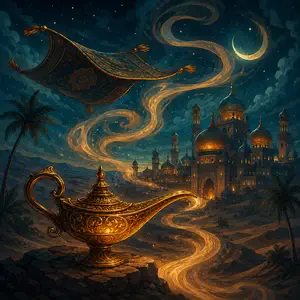 Arabian Mythology
 Arcane
 Avowed
 Aztec Mythology
 Baldur's Gate 3
 Black Myth: Wukong
 Blades in the Dark
 Bloodborne
 Brindlewood Bay
 Call of Cthulhu
 Cartography
 Celtic Mythology
 Changeling
 Chinese Mythology
 Chronicles of Narnia
 Civilization
 Clash of Clans
 Conlangs
 Cosmere
 Cosmic Horror
 Cozy Fantasy
 Cradle
 Creatures
 Crescent City
 Cryptids
 Cult of the Lamb
 Cultivation
 Daggerheart
 Dark Souls
 Demon: The Fallen
 Diablo
 Discworld
 Disney
 Dota 2
 Dragon Age
 Dragons
 Dungeons & Dragons
 Egyptian Mythology
 Elden Ring
 Elder Scrolls
 Eternal Strands
 Fae
Fae Final Fantasy
 Game of Thrones
 Genshin Impact
 God of War
 Gothic Horror
 Greek Mythology
 Guild Wars
 Hades II
 Hades
Hades Harry Potter
 Hindu Mythology
 His Dark Materials
 Hollow Knight
 Horror
 Indonesian myth
 Inheritance Cycle
 Japanese myth
 Korean Mythology
 League of Legends
 Legend of Zelda
 Legends of Runeterra
 LitRPG
 Lord of the Rings
 Lost Ark
 Magic: The Gathering
 Mayan Mythology
 Mesopotamian myth
 Minecraft
 Mistborn
 Monster Hunter
 Mythology
 Norse Mythology
 Path of Exile
 Pathfinder
 Percy Jackson
 Persian Mythology
 Pirate Borg
 Religion
 Rift
Rift RuneScape
 Sea of Thieves
 Sekiro
 Shadowdark
 Slavic Mythology
 Stardew Valley
 Steampunk
 Stonetop
 Stormlight Archive
 Tainted Grail
 The Dark Crystal
 The Dark Eye
 The Wheel of Time
 The Wildsea
 The Witcher
 Vampire: Masquerade
 Wakfu/Dofus
 Warhammer
 Werewolf Apocalypse
 Wings of Fire
 World of Darkness
 World of Warcraft
 Wuchang
 Wuxia
Wuxia Xianxia