More generators, writing tools and storytelling resources.
Why monster nests matter
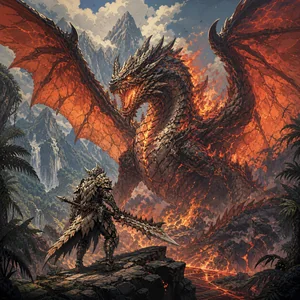
In Monster Hunter, a nest is more than a final arena. It is the place where a biome shows who truly rules it. Tracks, shed scales, fur caught on stone, snapped antlers, splintered trees, and the smell of blood or minerals all tell a story before the monster ever appears. Flying wyverns choose roosts with launch space, crosswinds, and long sightlines over migration routes. Burrowing threats carve dens into unstable ravines where loose earth becomes a weapon. Amphibious or leviathan-like creatures claim flooded caverns, reed beds, and steaming basins where hunters must fight current, mist, or mud as much as teeth and claws. Elder threats push the idea even further. Their presence changes the land itself, frosting cliffs, blackening canopies, electrifying pools, or turning fertile ground into a shrine of ash. A good nest location name should feel ecological, not decorative. It should suggest what the monster eats, how it rests, where it breeds, and why smaller life gives the area a wide and fearful berth.
Choosing the right nest location
Match the body plan
Start with movement. A heavy brute wyvern wants a chamber broad enough for turning, lunging, and body slams. A serpent or fanged wyvern favors tunnels, root tangles, and broken stone where it can vanish and strike from angles. Winged apex predators sound best in words that imply ledges, spires, crowns, and high caverns, while web-building, poisonous, or parasitic monsters suit sinkholes, mold grottos, husk pits, and damp brood hollows. When the name fits anatomy, the location instantly feels earned. Stonefist Throne sounds different from Brightfang Springs because one promises a dominant perch and the other hints at watering grounds stalked from cover.
Read the food web
Monster nests are always tied to feeding grounds. A predator that hunts herbivores near river flats may roost above open grazing land. A scavenger might sleep in sulfur vents, bone gullies, or carcass gardens where heat and decay keep rivals away. Some creatures drag food home, so their lairs are littered with shell fragments, snapped tusks, feathers, or ore-streaked bones. Others guard eggs and choose isolated brood sites protected by thorn thickets, freezing mists, lava shelves, or sheer cliffs. If you want the name to feel real, anchor it in prey, water, weather, and access. Hunters should hear the name and immediately picture why a monster would risk staying there despite competition, storms, and human patrols.
Signal threat level
Monster Hunter locations also need to communicate rank. A lower-tier den can sound local and practical, like Mossback Hollow or Redclaw Gully. A flagship wyvern nest should sound memorable enough for quest boards and campfire retellings, like Flarewing Crater or Riverjaw Chasm. Elder dragon strongholds should feel almost geological, as if the land itself had to reorganize around the creature, with names like Stormcrown Vault, Ashen Brood Caldera, or Frostvein Cathedral. Scale matters because hunters prepare differently when the map marker reads a common lair than when it sounds like a place that has broken expeditions before. A strong generator result helps you decide whether the scene is a scouting pass, a desperate capture run, or the final push into a hidden biome stronghold.
What a nest says about the monster
Local people do not name nests the way scholars do. Villagers, handlers, caravans, and guild scribes create names from fear, routine, and memory. One community may call a ravine Widow Roost because three hunters never came back, while the Guild records the same site as Sector Nine Cliff Cavern. That tension is useful. It lets you decide whether a nest name sounds official, superstitious, or half translated from generations of oral warnings. In setting terms, a nest location can reveal how long a monster has dominated the region, whether it migrates seasonally, and whether the ecosystem is collapsing or adapting around it. Names that mention ash, glass, rot, thunder, frost, spores, or bones make the nest feel embedded in the life cycle of the biome, not pasted onto a map for convenience.
Tips for writers and GMs
- Link the nest to a clear resource or hazard, such as sulfur vents, old shell beds, medicinal moss, or unstable crystal walls, so the location has value beyond a boss room.
- Let smaller monsters foreshadow the apex lair. Empty herbivore trails, scavenger swarms, or silence in the canopy make the final den feel like the center of a food web.
- Use two layers of naming when helpful: a Guild survey term for reports and a folk name hunters whisper at camp when they mean the same place.
- If the monster guards eggs or a mate, choose words like brood, nursery, clutch, or hatchery. If it is territorial rather than parental, favor throne, perch, court, or dominion.
- For elder threats, make the environment sound altered rather than merely occupied. The strongest names imply that wind, heat, poison, or lightning has become part of the architecture.
Inspiration prompts
Use these questions to turn a generated nest name into a full hunt setup, quest briefing, or story location.
- What sign tells hunters they have crossed from the ordinary biome into the monster's claimed ground?
- Which prey species, plants, or mineral deposits explain why this lair formed in this exact place?
- What old failed expedition, caravan rumor, or village taboo gave the nest its current name?
- How does the nest help the monster fight, escape, breed, or ambush more effectively than nearby terrain?
- If an elder dragon has claimed this site, what visible change proves the land has been reshaped around its power?
Frequently Asked Questions
Explore the most common questions about generating Monster Hunter nest locations and using them for maps, hunts, and environmental storytelling.
How does the Monster Nest Location Generator work?
It combines biome cues, monster behavior, threat level, and ecological detail to create lairs, dens, roosts, caverns, and feeding grounds that feel suited to a Monster Hunter-style hunt.
Can I specify the kind of nest I want?
Yes. Regenerate until a result matches your monster, or use the names as a base and lean them toward brood sites, elder dragon roosts, caverns, or hidden biome strongholds.
Are the nest locations unique?
The generator produces a wide variety of combinations, so most results will feel distinct. You can also rename a few terrain words to tailor a location to a specific monster family.
How many nest locations can I generate?
You can generate as many nest names as you need for quests, maps, expeditions, and guild records, whether you need one final arena or an entire biome full of lairs.
How do I save my favorite nest names?
Click any generated name to copy it instantly, or use the heart icon to save promising dens, roosts, and caverns for later when you build your hunt notes.
What are good monster nest locations?
There's thousands of random monster nest locations in this generator. Here are some samples to start:
- Cloudhorn Peak
- Ashwing Tundra
- Razorbeak Chasm
- Flarewing Crater
- Frosttusk Glen
- Brightfang Springs
- Riverjaw Chasm
- Stonefist Throne
- Icefang Cavern
- Sandspire Peak
About the creator
All idea generators and writing tools on The Story Shack are carefully crafted by storyteller and developer Martin Hooijmans. During the day I work on tech solutions. In my free hours I love diving into stories, be it reading, writing, gaming, roleplaying, you name it, I probably enjoy it. The Story Shack is my way of giving back to the global storytelling community. It's a huge creative outlet where I love bringing my ideas to life. Thanks for coming by, and if you enjoyed this tool, make sure you check out a few more!

 Saved ideas
  African Mythology
 Animal Crossing
 Arabian Mythology
 Arcane
 Avowed
 Aztec Mythology
 Baldur's Gate 3
 Black Myth: Wukong
 Blades in the Dark
 Bloodborne
 Brindlewood Bay
 Call of Cthulhu
 Cartography
 Celtic Mythology
 Changeling
 Chinese Mythology
 Chronicles of Narnia
 Civilization
 Clash of Clans
 Conlangs
 Cosmere
 Cosmic Horror
 Cozy Fantasy
 Cradle
 Creatures
 Crescent City
 Cryptids
 Cult of the Lamb
 Cultivation
 Daggerheart
 Dark Souls
 Demon: The Fallen
 Diablo
 Discworld
 Disney
 Dota 2
 Dragon Age
 Dragons
 Dungeons & Dragons
 Egyptian Mythology
 Elden Ring
 Elder Scrolls
 Eternal Strands
 Fae
Fae Final Fantasy
 Game of Thrones
 Genshin Impact
 God of War
 Gothic Horror
 Greek Mythology
 Guild Wars
 Hades II
 Hades
Hades Harry Potter
 Hindu Mythology
 His Dark Materials
 Hollow Knight
 Horror
 Indonesian myth
 Inheritance Cycle
 Japanese myth
 Korean Mythology
 League of Legends
 Legend of Zelda
 Legends of Runeterra
 LitRPG
 Lord of the Rings
 Lost Ark
 Magic: The Gathering
 Mayan Mythology
 Mesopotamian myth
 Minecraft
 Mistborn
 Monster Hunter
 Mythology
 Norse Mythology
 Path of Exile
 Pathfinder
 Percy Jackson
 Persian Mythology
 Pirate Borg
 Religion
 Rift
Rift RuneScape
 Sea of Thieves
 Sekiro
 Shadowdark
 Slavic Mythology
 Stardew Valley
 Steampunk
 Stonetop
 Stormlight Archive
 Tainted Grail
 The Dark Crystal
 The Dark Eye
 The Wheel of Time
 The Wildsea
 The Witcher
 Vampire: Masquerade
 Wakfu/Dofus
 Warhammer
 Werewolf Apocalypse
 Wings of Fire
 World of Darkness
 World of Warcraft
 Wuchang
 Wuxia
Wuxia Xianxia