More generators, writing tools and storytelling resources.
Origins and tone of the Lancer mech brief
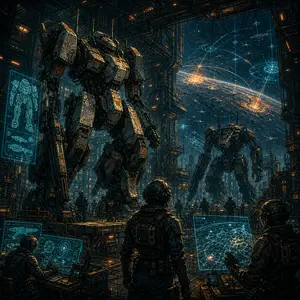
The Lancer tabletop role-playing game sets combat inside a near-future galaxy of licensed manufacturers, deployable strike frames, and pilots whose callsigns outlast the contracts they sign. A mech in Lancer is not just a chassis on a character sheet; it is a frame with a manufacturer license, a tailored loadout, a paint scheme with a story behind it, and a nickname the pilot uses over a crowded comms channel. The generator below leans into that level of detail. Every output is one short brief that bundles all five elements into a single readable paragraph, so the result feels like a hangar note rather than a name list.
Because the format is short and the framing is rich, you can take a single result and read it as is, or stretch it into a session opening, a recruitment poster, a journal entry, or a deployment order. Most briefs read as if a battery sergeant jotted them down at the end of a long shift. That grounded voice is the point: the output should land in your setting like it had been there all along.
Picking and using the briefs
Re-roll to find the cockpit voice
Because each brief is a complete unit, the simplest workflow is to keep rolling until the result sounds like the pilot you wanted to play. The chassis name, the loadout, and the callsign together do most of the character work. A heavy Gorgon with a sniper kit and a pilot called The Bookmark will read very differently from a Pegasus scout flown by someone called Hayride Tally, and you can tell at a glance which one is the brooding veteran and which is the eager junior.
Mix and match across results
If you like a loadout from one brief and a callsign from another, treat the list as a parts bin. The generator is built so the lens-based slices can be recombined. Pull a chassis and loadout from one roll, a paint scheme from another, and a pilot nickname from a third, and you have a custom brief that still feels native to the rest of your roster. The same trick works when you are seeding a mercenary company and want each pilot's entry to share a single hangar voice.
Anchor a brief to a theatre
Several lenses already lean into a specific operational theatre, such as the Ildira desert patrol, the Callisto ice run, or a Resting Foot militia rotation. When a result names a theatre, you can build a whole encounter around it: the enemy force, the weather, the supply chain, and the reason the squad is there all fall out of the same brief.
Identity, faction, and cultural weight
In Lancer, the manufacturer license is half the story. A frame licensed through Harrison Armory carries a different reputation than a chassis from IPS-N or SSC, and the licensing paperwork often follows the mech across multiple owners. The generator keeps that texture alive by always naming the license, the chassis, and the loadout in the same line. When you read a brief, you can feel whether the mech came off a corporate export list, a colonial co-op, or a pirate refit yard, and the pilot's callsign tends to reinforce the same vibe.
The cultural layer matters just as much. Pilots in Lancer borrow callsigns from old academy jokes, family words, payroll plans, repair bay superstitions, and small ledger nicknames. The generator leans on that pool, so the result sounds like a frame that has been in service long enough to pick up a working nickname, and the right kind of name for the right kind of pilot.
Tips for writers and GMs
- Treat the brief as a starting dossier, not a finished character. Expand the loadout, the licence, and the pilot's history once the result lands.
- Pair a brief with a single line of in-fiction context, such as a maintenance log entry or a mercenary company bio, and you have a ready-to-print roster card.
- When a callsign clashes with your campaign tone, swap it but keep the chassis, manufacturer, and loadout intact. The lens-based design is built for that kind of swap.
- Use two or three briefs from a single theatre lens to seed a coherent mercenary company or a planetary garrison without copy-pasting structure.
- For one-shots, lock in the brief and let the loadout define the session's tactical puzzle; the rest of the character will write itself.
Inspiration prompts
Take the next brief that catches your eye and answer one of these in a paragraph before you play.
- Where did the pilot first sit in the cockpit, and what did the deck crew call the frame that day?
- Which repair bay superstition is the maintenance lead quietly protecting, and why?
- What is the manufacturer's licensing officer's read on this owner, and is it filed yet?
- Which squad doctrine in your campaign would slot this frame into, and what is the working title?
- What is the paint scheme hiding, and which friend or enemy recognises it first?
Frequently Asked Questions
Common questions about the Lancer Mech Generator, with short answers to help you roll the perfect brief.
How does the Lancer Mech Generator work?
The generator surfaces mech briefs curated around the Lancer tabletop setting, randomised per click. Each brief combines a chassis, a manufacturer license, a loadout, a paint scheme, and a pilot callsign into a single readable line so you can drop it straight into a campaign.
Can I steer the Lancer Mech Generator toward a specific name angle?
Yes. Re-roll until a chassis, loadout, and callsign match the angle you want, and combine pieces from different briefs. The lens-based design lets you mix a loadout from one result with a callsign from another without losing the tone of the underlying brief.
Are the names original and safe to use?
Every brief is original to this generator and free to use in personal and most commercial Lancer or Lancer-adjacent work. The output does not copy canon frame names, manufacturer trademarks, or specific pilot callsigns from the published source material.
How many names can I generate?
You can re-roll as often as you like, and every result is a fresh brief. The underlying list is broad enough that you can run an entire mercenary company through the generator without significant repetition, so the practical limit is your campaign, not the tool.
How do I save the names I like?
Click the result to copy it to your clipboard, or use the heart icon to save the brief to your favourites list. Saved briefs can be reviewed later in the same session or carried into a new one.
What are good Lancer Mech briefs?
There's thousands of random Lancer Mech briefs in this generator. Here are some samples to start:
- Tabled manticore-class striker frame dubbed Foxglove Hour, a fast mech that drops into the engagement envelope and pivots out before the second volley lands
- Harrison Armory Saladin called Stipend, a licensed assault frame bought under a payroll deduction plan the battalion finance office still audits quarterly
- Routed gorgon heavy chassis the night-shift pilots call Big Cousin, a heavy frame the gunners named after a relative of theirs who always borrowed the truck
- Traced manticore striker variant called Saltbook, kitted with a combat knife, a flak cannon, and a rangefinder the gun-line dubs the field atlas
- Promoted manticore-pattern striker painted the color of boiled beetroot and called Hour of the Goat by the reservists it was last assigned to
- On viceroy-pattern carrier the hangar crew renamed Ration Day, painted with a chalk tally on the left toe for every sortie it came back from
- Lich-class heavy codenamed Kingfisher's Grief on the dorsal spine, the callsign was a private joke from the original owner that nobody fixed
- Refitted saladin assault chassis with a Ssrin-mark NHP the pilot calls The Auditor, an unshackled personality that catalogs every override and queries the log on cold starts
- Cleared vortex-pattern scout working the flanker role in a hunter cell called The Thursday Reading Club, an old academy joke that survived deployment
- The gorgon heavy chassis shipped out of an Ildira mining guild and called Salt Invoice, a militia callsign the loadmaster kept on the cargo manifest as a private joke
About the creator
All idea generators and writing tools on The Story Shack are carefully crafted by storyteller and developer Martin Hooijmans. During the day I work on tech solutions. In my free hours I love diving into stories, be it reading, writing, gaming, roleplaying, you name it, I probably enjoy it. The Story Shack is my way of giving back to the global storytelling community. It's a huge creative outlet where I love bringing my ideas to life. Thanks for coming by, and if you enjoyed this tool, make sure you check out a few more!

 Saved ideas
  Alien: Earth
 Apex Legends
 Assassin's Creed
 Babylon 5
 Battlestar Galactica
 Clair Obscur
 Cyberpunk 2077
 Cyberpunk RED
 Cyberpunk
 DC Universe
 Destiny
 Dieselpunk
 Doctor Who
 Dune
Dune Dystopia
 Eclipse
 EVE Online
 The Expanse
 Fallout
 Fortnite
 Halo
Halo Helldivers
 Horizon Zero Dawn
 Invincible
 Lancer
 Marvel Universe
 Mass Effect
 Mecha
Mecha No Man's Sky
 Overwatch
 Shadowrun
 Space Opera
 Split Fiction
 Star Trek
 Star Wars
 Starfinder
 Stargate
 The Culture
 The Last of Us
 Things from the Flood
 Tides of Annihilation
 Transformers
 Valorant
 Voltron
 Warhammer 40K
 Wildstar