More generators, writing tools and storytelling resources.
Build clue trails that feel found
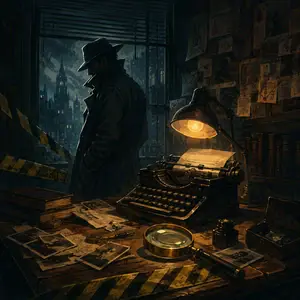
ARG scavenger clues sit between story beat, puzzle prop, and public performance. A good clue does not explain the whole mystery. It gives players something to notice, test, photograph, decode, argue over, or carry to the next location. The strongest results often look ordinary first: a receipt, a sticker, a handle in a comment thread, a taped postcard, or a map cropped just enough to annoy everyone. This generator focuses on compact clue ideas, so you can add texture to a hunt without turning every result into a full scene outline.
How to use the generated clues
Choose the clue medium first
Start by deciding how the clue reaches the players. A voicemail creates intimacy, a poster creates public pressure, a receipt suggests commerce or surveillance, and a forum reply can make the trail feel watched. Once the medium is clear, the rest becomes easier to adapt. Change a generic place into a story location, replace a handle with a recurring in-world account, and decide whether the clue solves a puzzle, baits a mistake, or reveals that someone else is moving through the trail.
Connect the drop site to the payoff
A scavenger clue works best when the place and payoff speak to each other. A map hidden near a closed arcade can point to childhood, abandoned entertainment, or a sponsor trying to look playful. A ticket stub under a station bench can imply travel, escape, or a route that no longer exists. Use the generated phrase as a pressure point, then ask what players must do with it. They might align it with a photograph, call a number, reorder a playlist, compare timestamps, or notice a lie in the public version of events.
Keep the ARG boundary clear
If your project enters real spaces, design with safety and consent in mind. Do not send players into restricted areas, private property, active roads, or places where bystanders could feel targeted. Fictional handles should not impersonate real people. Physical drops should be retrievable without damage or trespass. You can still create unease with timing, misdirection, social fallout, and moral choices, but players should always have a safe, obvious way to step away.
Practical clue-writing tips
- Give each clue one job: point to a place, unlock a code, reveal a relationship, or change what players believe.
- Make the clue object specific enough to remember, such as a scratched key tag or a milk carton with a misprinted date.
- Pair online and real-world evidence so players feel the trail crossing from screen to street.
- Use false trails carefully. A red herring should teach something, not punish attention.
- Add a backup clue for every critical puzzle beat, especially when weather, opening hours, or player schedules matter.
- Test physical tasks with someone outside the design team before asking players to attempt them.
Questions to shape the next clue
Use these prompts when a generated clue feels close but not yet ready for play.
- Who planted this clue, and what do they gain if players follow it?
- What ordinary detail makes the clue seem natural in its location?
- What action must players take before the clue becomes useful?
- What makes this clue suspicious without making it impossible?
- How can the clue create pressure without creating unsafe behavior?
- What does the public story claim, and what does the clue quietly contradict?
How does the ARG Scavenger Clue Generator work?
The generator mixes clue-oriented angles such as medium, handle, drop site, obstacle, countdown, reveal, and consequence. Each click surfaces a concise result you can treat as a prompt, prop label, or starting point for a puzzle beat.
Can I steer the ARG Scavenger Clue Generator toward a specific name angle?
Yes. Re-roll until the clue leans toward the kind of scene you need, then combine parts from multiple results. A handle from one result can pair with a location, object, or payoff from another.
Are the names original and safe to use?
The results are written for this generator and are intended for personal projects and most commercial storytelling uses. For a public ARG, still rename real locations, brands, and accounts that could confuse bystanders.
How many names can I generate?
You can keep generating as often as you need. Use several rolls to build a trail, compare tones, or collect backup clues for players who miss the first solution path.
How do I save the names I like?
Click a result to copy it, or use the heart or save icon to keep favorites. Saving a few nearby options helps you preserve alternate routes, red herrings, and backup clues.
What are good ARG scavenger clues?
There's thousands of random ARG scavenger clues in this generator. Here are some samples to start:
- Lantern Amber Breadcrumb Amber Voicemail Decode Button at Glass Cinema Marquee
- Moth Amber Medium Amber Sticker Code Rearrange Cassette at Glass East Stairwell
- Receipt Amber Handle Amber Receipt Cipher Photograph Bookmark at Glass Dry Fountain
- Kiosk Amber Drop Site Amber Metro Map Fold Coin at Glass Mural Wall
- Courier Amber Trigger Amber Photo Caption Scratch Patch at Glass Canal Bench
- Oracle Amber Detail Amber Forum Poll Dial Key Tag at Glass Old Turnstile
- Keyhole Amber Witness Amber Video Glitch Compare Poster at Glass Photo Booth
- Signal Amber Pressure Amber Playlist Order Circle Envelope at Glass Bell Tower
- Turnstile Amber Barrier Amber Graffiti Arrow Trace Napkin at Glass Parcel Locker
- Archive Amber Countdown Amber Library Stamp Invert Ledger Page at Glass Rooftop Garden
About the creator
All idea generators and writing tools on The Story Shack are carefully crafted by storyteller and developer Martin Hooijmans. During the day I work on tech solutions. In my free hours I love diving into stories, be it reading, writing, gaming, roleplaying, you name it, I probably enjoy it. The Story Shack is my way of giving back to the global storytelling community. It's a huge creative outlet where I love bringing my ideas to life. Thanks for coming by, and if you enjoyed this tool, make sure you check out a few more!

 Saved ideas