More generators, writing tools and storytelling resources.
Why Overwatch hero concepts feel distinct
Overwatch heroes rarely begin with a weapon alone. The roster usually starts with silhouette, job, national context, and moral angle, then gameplay details lock into that frame. Tanks are readable at distance, supports advertise trust or deception, and damage heroes sell rhythm through movement and burst timing. Even before a voice line lands, you can often guess whether someone belongs beside Overwatch, Talon, Vishkar, MEKA, the Junkers, Helix Security, the Shambali, or a harsher omnic movement. That matters for fan heroes too. A believable concept is not just cool gear. It is a point of view on the post-Omnic Crisis world, expressed through costume material, ability cadence, faction loyalty, and the sentence the hero shouts when the ultimate starts. This generator leans into that full bundle, so each result reads more like a roster pitch than a random codename.
Using the generator well
Start with role pressure
Read the role first and ask what battlefield pressure it creates. A tank should reshape space, peel for teammates, or force timing windows. A support should change survival math, tempo, or information flow. A damage hero should threaten routes, punish greed, or open chokepoints. If the brief says pulse defender, riot anchor, skyline tactician, or reef medic, do not treat that as flavor text. It is the gameplay fantasy. Once you know what pressure the hero applies, you can imagine range, movement, cooldown personality, and the maps where they would feel terrifying or reassuring.
Tie powers to place and institution
Origin is more than a passport stamp. Overwatch has always sold a worldwide roster by linking character design to place, infrastructure, language rhythm, and political context. A Busan ally feels different from a Junkertown bruiser because the materials, institutions, and anxieties are different. MEKA suggests defense readiness, celebrity pressure, and machine polish. Vishkar brings civic engineering, hard-light order, and ethical tension. Talon frames ambition, coercion, and cultivated menace. The Junkers read as opportunistic survival built from scarcity and spectacle. Use the city or region in each result as a design clue. Ask what a harbor, mine, temple district, megacity rail line, refinery, or glacier rescue zone would teach someone to value.
Write the ultimate and voice line last
The ult name and catchphrase should feel like the sharpest expression of the concept, not the first decoration you grab. In Overwatch, ult lines are tiny mission statements. They tell you whether the hero is noble, vain, clinical, mocking, devout, exhausted, or ecstatic. Good ult names also imply function. A title like Harbor Lock, Lotus Fever, Monorail Crown, or Bell of Stillness suggests zone control, affliction, urban dominance, or mass calm before you even animate it. When you expand a generated brief, treat the ult as the final compression of the hero's worldview. If the line sounds generic, the concept probably still needs a clearer motive.
Why hero concepts carry identity weight
Overwatch heroes resonate because nationality is not a cosmetic layer pasted over the same template. Accent, slang, architecture, corporate ties, food, local weather, class history, religion, and public institutions all change how a person would fight and what they believe protection costs. The faction field matters for the same reason. An Overwatch loyalist imagines service, recall politics, and cooperation under pressure. A Talon operative sees leverage, hierarchy, and ambition. A Vishkar loyalist may sincerely believe clean order helps cities, while a rogue defender or neighborhood hero is shaped by local neglect and improvisation. Voice lines are where those values become audible. A good fan hero stops feeling generic the moment the role, homeland, and faction all pull in the same emotional direction.
Tips for writers
- Design the silhouette before the backstory. Players remember outline, movement, and weapon posture faster than lore paragraphs.
- Keep the role readable. If your hero is a support, the brief should imply how they help allies, not only how stylish their damage looks.
- Let factions complicate morality. A Vishkar or Helix hero should have institutional logic, not cartoon villainy or instant sainthood.
- Use the ult as a gameplay promise. The name should hint at area denial, rescue, burst damage, scouting, mobility, or crowd control.
- Give the catchphrase a human voice. One short sentence should reveal whether the hero is mocking, calm, compassionate, hungry, devout, or tired.
Inspiration prompts
Use these questions when you want a generated brief to become a full hero sheet instead of a cool one-line idea.
- What map type would this hero transform the most: tight urban choke, open escort lane, vertical control point, or stormy coast?
- Who hates this hero on sight, and which faction quietly wants to recruit, silence, or steal them?
- What everyday job, civic duty, or trauma taught them the exact habit that became their signature ult?
- If this hero met an existing tank, support, or damage legend, would the result be rivalry, mentorship, suspicion, or painful recognition?
- What does the catchphrase sound like in private, when the cameras are gone and the fight is not theatrical anymore?
Frequently Asked Questions
Explore the most common questions about the Hero Generator (Overwatch) and how it can help you build a convincing roster concept.
How does the Hero Generator (Overwatch) work?
Each click combines a role, regional point of view, faction loyalty, ultimate concept, and voice-line tone so the result feels like an actual hero pitch rather than a loose aesthetic phrase.
Can I aim for a tank, support, damage, or specific faction idea?
Yes. Keep rerolling until the role or faction matches your need, then expand the brief around abilities, silhouette, and map pressure that fit that lane.
Are the generated hero briefs unique?
The pool is large and mixes different regions, institutions, combat functions, and tonal cues, so repeated clicks keep producing distinct hero seeds instead of one repeated formula.
How many hero ideas can I generate?
You can generate as many hero concepts as you want, which makes the tool useful for one OC, a full fan roster, or a themed event lineup.
How do I save my favorite hero concepts?
Click any result to copy it instantly, or use the heart icon to keep strong briefs nearby while you sketch abilities, art notes, and dialogue.
What are good Overwatch heroes?
There's thousands of random Overwatch heroes in this generator. Here are some samples to start:
- Accra pulse defender, Overwatch reserve, ult Sunwall Choir
- 'Stand in the heat.'
- Seattle code butcher, Talon ghost team, ult Firewall Funeral
- 'Your map is mine.'
- Yogyakarta batik hacker, MEKA ally, ult Threadstorm Patch
- 'I stitched the trap.'
- Mumbai skyline tactician, Vishkar command, ult Monorail Crown
- 'Cities kneel to plans.'
- Alice Springs scrap bruiser, Junker loyalist, ult Rust Crown
- 'Sand eats all.'
- Kathmandu omnic pacifist, Shambali ally, ult Bell of Stillness
- 'Lower your hands.'
- Cairo rooftop medic, Helix Security, ult Minaret Ward
- 'Stay in my sight.'
- Reykjavik glacier medic, Overwatch climate wing, ult Blue Melt
- 'Hands warm first.'
- Buenos Aires tango duelist, rogue defenders, ult Last Embrace
- 'Step closer.'
- Aberdeen coil ranger, Blackwatch remnant, ult Granite Split
- 'Quiet was an option.'
About the creator
All idea generators and writing tools on The Story Shack are carefully crafted by storyteller and developer Martin Hooijmans. During the day I work on tech solutions. In my free hours I love diving into stories, be it reading, writing, gaming, roleplaying, you name it, I probably enjoy it. The Story Shack is my way of giving back to the global storytelling community. It's a huge creative outlet where I love bringing my ideas to life. Thanks for coming by, and if you enjoyed this tool, make sure you check out a few more!

 Saved ideas
  Alien: Earth
 Apex Legends
 Assassin's Creed
 Babylon 5
 Battlestar Galactica
 Clair Obscur
 Cyberpunk 2077
 Cyberpunk RED
 Cyberpunk
 DC Universe
 Destiny
 Dieselpunk
 Doctor Who
 Dune
Dune Dystopia
 Eclipse
 EVE Online
 The Expanse
 Fallout
 Fortnite
 Halo
Halo Helldivers
 Horizon Zero Dawn
 Invincible
 Lancer
 Marvel Universe
 Mass Effect
 Mecha
Mecha No Man's Sky
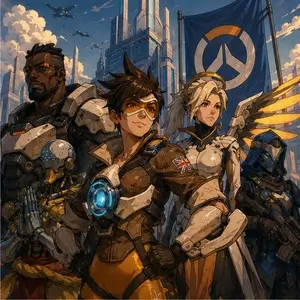 Overwatch
 Shadowrun
 Space Opera
 Split Fiction
 Star Trek
 Star Wars
 Starfinder
 Stargate
 The Culture
 The Last of Us
 Things from the Flood
 Tides of Annihilation
 Transformers
 Valorant
 Voltron
 Warhammer 40K
 Wildstar