More generators, writing tools and storytelling resources.
Guilds Between Genres
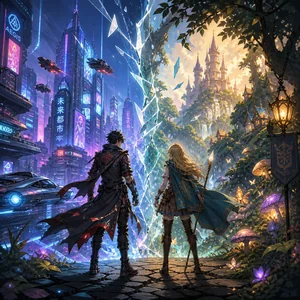
Split Fiction thrives on collision. One scene can feel like a heroic fantasy raid through rune-lit ruins, while the next feels like a neon escape executed with drones, rail lines, and unstable code. A guild name in that kind of setting has to do more than label a group. It has to bridge tones. The best names sound convincing on a tavern wall, on a mission board, in a hacked transmission, and in the margin notes of a writer who knows the story is being bent in real time. That is why guild names for Split Fiction work especially well when they suggest teamwork, authorship, secrecy, and movement. A good result can imply a daring adventuring party, a covert resistance unit, a stylish book club that is secretly a spy ring, or a world-spanning order that exists because two story logics have learned how to cooperate. The name becomes a promise about how the group survives the friction between fantasy ritual and sci-fi improvisation.
How To Use These Names
For adventuring parties and field crews
If you are naming a playable team, look for a result that sounds active rather than ceremonial. Words such as wardens, wanderers, syndicate, circle, and cohort suggest a party that moves together, solves problems together, and probably improvises under pressure. These are useful for co-op heroes, mercenary teams, salvage crews, courier units, and duos that keep expanding into a larger found family. A sharp guild name can also help each character feel more defined, because it hints at what the group values when the plot starts pulling them into different genres at once. The more a result feels like it belongs on armor, devices, maps, and mission chatter, the more useful it becomes during play.
For secret clubs, resistance cells, and hidden alliances
Split Fiction also invites names that sound like they belong to people working under narrative pressure. A secret society might use literary language to hide its real purpose. A resistance cell might choose something elegant and coded so it can pass as a reading circle, archive society, or cultural order while planning sabotage in the background. Names that imply mirrors, drafts, keys, margins, or threads are strong here because they feel both symbolic and operational. They can belong to rebels in a techno-city, masked conspirators in a fantasy capital, or an alliance that moves quietly between the two. That ambiguity gives you useful story tension, because the same name can sound noble in public and dangerous in private.
For story-world institutions and meta-fictional factions
Some results feel larger than a party. Use those for academy orders, transmedia councils, rival author guilds, archive bureaucracies, canon police, or organizations that believe stories themselves can be defended, stolen, revised, or weaponized. This is where Split Fiction becomes especially fun. A guild name can imply not just a profession, but a theory of reality. An order called the Chapter Choir sounds different from one called the Second Draft Syndicate, even if both are powerful. One suggests harmony and ritual, the other suggests revision, manipulation, and deliberate intervention. When you want a group to feel like it shapes worlds instead of merely surviving them, choose a result that sounds ideological as well as stylish.
What A Split Fiction Guild Name Communicates
A strong Split Fiction guild name carries cultural weight because it explains how a group wants to be seen inside a fractured narrative universe. Noble names feel like they belong to public defenders, ceremonial houses, and adventuring companies that want admiration. Sleeker or stranger names feel like they belong to smugglers, coders, underground editors, continuity thieves, or cells that understand every world is half performance. The language you choose tells players and readers whether the group prizes loyalty, style, secrecy, rebellion, scholarship, or myth. It also tells you how that faction probably dresses, what symbols it paints on equipment, how it recruits, and what rumors follow it. In a setting where fantasy banners and sci-fi interfaces coexist, the name is often the fastest way to make an organization feel intentional rather than generic. It gives the group a social texture before any member even speaks.
Tips For Choosing The Right Banner
- Pick names with motion for crews that travel often, raid boldly, or improvise across shifting worlds and timelines.
- Choose terms with literary texture for hidden clubs, archive societies, or organizations that feel aware of authorship and revision.
- Use cleaner, sharper wording for sci-fi factions, then richer and more ceremonial words for fantasy parties and public orders.
- Think about what the group wants outsiders to believe, because polished names can hide rebels just as easily as they can announce heroes.
- Let the guild name hint at symbols, uniforms, passwords, or rituals so the organization feels usable the moment it enters a scene.
Inspiration Prompts
Use these prompts to turn a good result into a group with history, conflict, and a clear role in your story.
- What event forced this guild to unite fantasy customs with sci-fi tactics?
- Which member interprets the guild name as prophecy, and which sees it as branding?
- What rival faction mocks the banner openly but fears it in private?
- Which city, fortress, station, or archive first gave this guild public meaning?
- What object, oath, or shared failure made the name impossible to abandon?
Frequently Asked Questions
Explore the most common questions about the Split Fiction Guild Name Generator and how it helps you name stylish teams, factions, and mixed-genre organizations.
How does the Split Fiction Guild Name Generator work?
Click Generate to pull a guild name from a curated library built for crews, factions, secret clubs, resistance cells, and story-world organizations that blend fantasy and sci-fi energy.
Can I aim the results toward fantasy teams or sci-fi factions?
Yes. Generate a few options, then keep the names whose vocabulary feels more ceremonial, more futuristic, more covert, or more rebellious for the kind of organization you want.
Are the guild names unique?
The generator draws from a wide pool of original names, so the results stay varied and usually give you a banner that feels distinct from generic team labels.
How many guild names can I generate?
There is no hard limit. Keep generating until you find the right name for a party, guild, resistance cell, secret club, archive order, or cross-world faction.
How do I save my favorite guild names?
Click the heart icon to save a favorite, or click the generated name itself to copy it instantly into your notes, campaign outline, or worldbuilding file.
What are good Split Fiction guild names?
There's thousands of random Split Fiction guild names in this generator. Here are some samples to start:
- Braided Editors
- Wardens of the Glass Thread
- The Chapter Choir
- The Unbound Cohort
- Echo Wanderers
- The Second Draft Syndicate
- The Atlas Mirrored
- Mio Wardens
- Chronicle Masons
- Mandate of the Iron Colophon
About the creator
All idea generators and writing tools on The Story Shack are carefully crafted by storyteller and developer Martin Hooijmans. During the day I work on tech solutions. In my free hours I love diving into stories, be it reading, writing, gaming, roleplaying, you name it, I probably enjoy it. The Story Shack is my way of giving back to the global storytelling community. It's a huge creative outlet where I love bringing my ideas to life. Thanks for coming by, and if you enjoyed this tool, make sure you check out a few more!

 Saved ideas
  Alien: Earth
 Apex Legends
 Assassin's Creed
 Babylon 5
 Battlestar Galactica
 Clair Obscur
 Cyberpunk 2077
 Cyberpunk RED
 Cyberpunk
 DC Universe
 Destiny
 Dieselpunk
 Doctor Who
 Dune
Dune Dystopia
 Eclipse
 EVE Online
 The Expanse
 Fallout
 Fortnite
 Halo
Halo Helldivers
 Horizon Zero Dawn
 Invincible
 Lancer
 Marvel Universe
 Mass Effect
 Mecha
Mecha No Man's Sky
 Overwatch
 Shadowrun
 Space Opera
 Split Fiction
 Star Trek
 Star Wars
 Starfinder
 Stargate
 The Culture
 The Last of Us
 Things from the Flood
 Tides of Annihilation
 Transformers
 Valorant
 Voltron
 Warhammer 40K
 Wildstar