More generators, writing tools and storytelling resources.
What makes a dieselpunk city feel convincing?
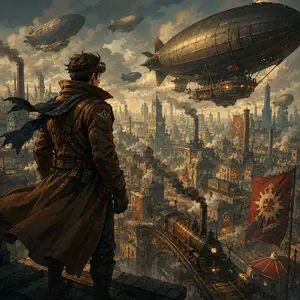
Dieselpunk cities grow from the machinery, politics, and visual confidence associated with the years between the world wars and the imagined futures built from that period. Their streets may carry streamlined buses, armored limousines, fuel tankers, elevated rail lines, and workers changing shifts beneath monumental towers. The strongest names suggest a system behind the skyline. A place called Iron Junction implies transport and industry, while Brass Nocturne hints at nightlife, music, and polished decay. The name does not need to explain the whole city, but it should point toward the pressure that shaped it.
Choose a name by deciding who controls the city
Industry and infrastructure
Begin with what keeps the city alive. Refinery districts produce names built around crude oil, tanks, flare stacks, and pipelines. Rail terminals favor signals, platforms, locomotives, and switchyards. Airship lanes introduce mooring masts, hangars, navigators, and high-altitude routes. These practical systems can become civic symbols, family fortunes, or military targets. A city named for a machine often feels planned, hierarchical, and dependent on uninterrupted production.
Power, class, and resistance
Next decide who claims ownership. An oil dynasty might stamp its surname on avenues and public buildings. A company town may sound efficient and respectable while hiding debt, surveillance, or dangerous labor. A worker republic may instead celebrate unions, councils, solidarity, and rebuilt factories. Black-market freeports and jazz-club quarters create unofficial names used after dark, especially where smugglers, musicians, and dissidents share the same basements.
Climate and geography
Geography changes the vocabulary. Desert fuel outposts rely on wells, caravans, heat, dust, and distant rail links. Polar ports need icebreakers, pipelines, and extraction rigs. River foundry cities combine locks, mills, docks, and furnaces, while mountain settlements grow around tunnels and drilled passes. Let the landscape make production harder, then allow the city name to celebrate or conceal that struggle.
Use the name as a worldbuilding anchor
A city name becomes useful when it produces questions. Who first used it, and who refuses to use it now? Is it an official title printed on station clocks, a corporate brand, a revolutionary renaming, or a nickname heard in jazz cellars? Connect the result to one skyline landmark, one economic dependency, and one unresolved conflict. This turns a compact label into a setting that can support characters, factions, maps, and stories.
Practical tips for adapting a result
- Say the name aloud beside the names of nearby cities to check rhythm and regional consistency.
- Choose whether the name is official, historical, corporate, military, or used only by residents.
- Add one dominant transport system, such as rail, airship, river freight, or armored road convoys.
- Give the city a resource it cannot easily replace, such as fuel, ore, electricity, or skilled labor.
- Create a landmark that visually explains the name without repeating it word for word.
- Write a contrasting neighborhood name so the city feels socially divided rather than uniformly themed.
Questions that open the city
Use these prompts to move from a name to a functioning place with history and tension.
- What can be seen from the highest tower when the factory shift changes?
- Which family, ministry, company, or union benefits most from the city’s current name?
- What route must remain open for food, fuel, or military supplies to arrive?
- Where do musicians, smugglers, workers, and informants meet after curfew?
- What older district survived beneath the new monuments and elevated tracks?
- What event could force the city to rename itself again?
How does the Dieselpunk City Generator work?
Each click selects a city name from a topic-focused pool shaped by industrial skylines, oil dynasties, airship routes, jazz clubs, factories, rail hubs, and related dieselpunk settings.
Can I steer the Dieselpunk City Generator toward a specific name angle?
Reroll until a particular angle appears, then combine the chosen name with a district, ruling company, resistance cell, landmark, or transport route from another result or your own notes.
Are the names original and safe to use?
The names are written for this generator and may be used in personal projects and most commercial work. For publication, still check trademarks and prominent existing uses in your market.
How many names can I generate?
You can reroll as often as needed. Save several contrasting options, compare how they sound beside character and faction names, and keep the one that best supports your setting.
How do I save the names I like?
Use the copy control to place a result on your clipboard. When available, select the heart or save icon to keep promising names together while you continue exploring.
What are good Dieselpunk Cities?
There's thousands of random Dieselpunk Cities in this generator. Here are some samples to start:
- Aureate Spire
- Voss Fuel City
- Captain Skyward
- Iron Junction
- Vapor Column
- Frostline Depot
- Propeller Harbor
- Freeport Valve
- Blue Spark
- Postwar Plaza
About the creator
All idea generators and writing tools on The Story Shack are carefully crafted by storyteller and developer Martin Hooijmans. During the day I work on tech solutions. In my free hours I love diving into stories, be it reading, writing, gaming, roleplaying, you name it, I probably enjoy it. The Story Shack is my way of giving back to the global storytelling community. It's a huge creative outlet where I love bringing my ideas to life. Thanks for coming by, and if you enjoyed this tool, make sure you check out a few more!

 Saved ideas
  Alien: Earth
 Apex Legends
 Assassin's Creed
 Babylon 5
 Battlestar Galactica
 Clair Obscur
 Cyberpunk 2077
 Cyberpunk RED
 Cyberpunk
 DC Universe
 Destiny
 Dieselpunk
 Doctor Who
 Dune
Dune Dystopia
 Eclipse
 EVE Online
 The Expanse
 Fallout
 Fortnite
 Halo
Halo Helldivers
 Horizon Zero Dawn
 Invincible
 Lancer
 Marvel Universe
 Mass Effect
 Mecha
Mecha No Man's Sky
 Overwatch
 Shadowrun
 Space Opera
 Split Fiction
 Star Trek
 Star Wars
 Starfinder
 Stargate
 The Culture
 The Last of Us
 Things from the Flood
 Tides of Annihilation
 Transformers
 Valorant
 Voltron
 Warhammer 40K
 Wildstar