More generators, writing tools and storytelling resources.
Building dramatic courtroom scenes
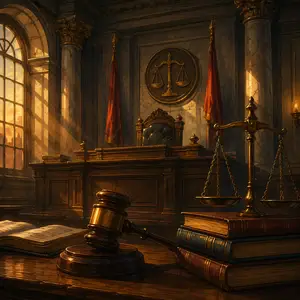
Courtroom scenes work because they put conflict inside a formal structure. A character cannot simply chase, hide, or shout their way through the problem. They must answer questions, obey rules, watch the audience, and decide how much truth can be spoken in public. That tension makes a trial scene useful for mysteries, thrillers, historical fiction, fantasy tribunals, political drama, family stories, and even quiet character pieces. The prompt can point toward a murder charge, a disputed will, a forged document, a hostile cross examination, a breach of security, or a verdict that refuses to arrive cleanly.
Using a prompt in your draft
Find the pressure point
Start by identifying what the prompt threatens. It might threaten the defendant, the witness, the judge, the attorney, the jury, or the public story around the case. Good courtroom drama rarely depends on a legal trick alone. It depends on what a person stands to lose if the room accepts one version of events. A prompt about a sealed record, for example, may ask whether privacy protects someone or hides a necessary truth.
Give every side a reason
A strong scene does not need a villain in every chair. The prosecutor may be overreaching because the public wants closure. The defense may hide a fact because disclosure would harm an innocent person. A judge may seem cold because a private threat has narrowed every ruling. Treat each side as strategic, afraid, proud, or compromised. The court becomes more interesting when nobody is merely waiting to deliver exposition.
Let procedure shape suspense
Rules can create rhythm. Objections interrupt momentum. A recess gives characters a chance to bargain in the hallway. A ruling can allow one piece of evidence and exclude another. A juror poll can turn a verdict into a new conflict. You do not need detailed legal realism for every genre, but the scene should respect its own rules. If a rule matters, show who understands it, who exploits it, and who pays for breaking it.
Genre and context
The same courtroom prompt can bend toward different genres. In a medieval tribunal, the witness may risk exile or execution. In a modern thriller, the danger may come from media pressure or compromised evidence. In fantasy, a magical oath or divination can behave like contested expert testimony, as long as the court has rules for how that proof is weighed. The key is to keep the central human question clear. Who is believed, who is protected, and who is sacrificed when the official record is written?
Practical tips for stronger scenes
- Choose one dominant turn for the scene, such as a witness reversal, evidence reveal, or judge ruling.
- Give the gallery a role when public pressure should affect testimony or courage.
- Use a specific object, document, or record so the conflict has something visible to focus on.
- Let one character misunderstand the rules while another uses them with precision.
- Make the private cost of honesty different from the public cost of lying.
- End the scene with a changed question, not only a changed answer.
Questions to develop the prompt
After rolling a courtroom scene prompt, use it as a seed rather than a finished outline. These questions help turn the result into a scene with stakes, texture, and consequence.
- What does the court believe at the start, and who benefits from that belief?
- Which character knows the prompt's central fact before the scene begins?
- What rule, ritual, or custom limits what can be said aloud?
- Who in the room is watching for personal reasons rather than legal ones?
- What evidence looks small until the right question gives it meaning?
- How should the verdict, ruling, or interruption change the next chapter?
How does the Courtroom Scene Prompt Generator work?
It presents a randomized courtroom scene prompt each time you roll, drawing on case type, witness pressure, prosecution choices, defense tactics, judge tension, and evidence reveals.
Can I steer the Courtroom Scene Prompt Generator toward a specific prompt angle?
Use the result that is closest to your intended angle, then re-roll for nearby pressure points. Combining two prompts often gives a stronger case, witness, and twist.
Are the prompts original and safe to use?
The prompts are written for this generator and can be adapted for personal drafts, game prep, scripts, and most commercial writing projects.
How many prompts can I generate?
You can keep re-rolling as you test different scene directions. Save the prompts that create useful pressure, then return when your story needs another courtroom turn.
How do I save the prompts I like?
Click a result to copy it, or use the heart and save controls to keep promising prompts close while you plan the case.
What are good Courtroom Scene Prompts?
There's thousands of random Courtroom Scene Prompts in this generator. Here are some samples to start:
- A murder charge against a beloved physician turns when the blood-spotted travel cloak points toward a fact both lawyers hoped to avoid.
- In a packed maritime court, sailors pounding the gallery rail forces the court to decide whether to pause the case or press on.
- A whispered objection exposes that the prosecutor planted a harmless error on purpose, leaving both sides unsure who benefits.
- The judge must rule on a burned warehouse inventory while anonymous letters naming the judge's daughter grow louder outside the courtroom.
- When a cracked signet ring is admitted as evidence, the master of chancery notices a detail no one else mentioned.
- The courtroom falls quiet when a physician who studies uncommon minerals names a split among doctors as the reason the story changed.
- During a land dispute poisoned by a forged deed, a monk trained in old scripts enters the room and contradicts the monastery copybook.
- The accused sees a folder tied with red tape on the evidence table and suddenly refuses to answer any more questions.
- Before the jury can settle, headlines predicting the verdict turn glare and noise into the real mood of the room.
- The scene ends in the second before the foreman speaks, as everyone realizes the verdict may be void before it is spoken.
About the creator
All idea generators and writing tools on The Story Shack are carefully crafted by storyteller and developer Martin Hooijmans. During the day I work on tech solutions. In my free hours I love diving into stories, be it reading, writing, gaming, roleplaying, you name it, I probably enjoy it. The Story Shack is my way of giving back to the global storytelling community. It's a huge creative outlet where I love bringing my ideas to life. Thanks for coming by, and if you enjoyed this tool, make sure you check out a few more!

 Saved ideas