More generators, writing tools and storytelling resources.
Climate fiction as lived pressure
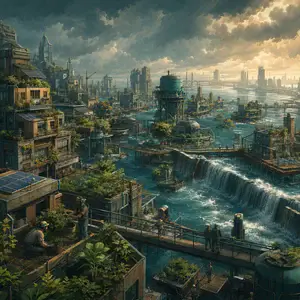
Climate fiction, often shortened to cli-fi, works best when the changing planet is felt through ordinary decisions. A flood map can decide who receives a buyout. A heat shelter can become a place where neighbors renegotiate care. A seed vault, microgrid, courtroom, reef nursery, or relocation archive can hold both technical hope and social conflict. This generator focuses on those points of contact. It treats climate hazards as narrative forces that move through housing, food, work, language, law, family memory, and public trust.
Using a generated story prompt
Find the human decision
Start by asking who has to act before the situation hardens. The prompt may name a clerk, diver, farmer, child, engineer, nurse, or witness, but the useful center is the choice they face. Make that choice costly. If everyone agrees, the premise will stay flat. If a technology solves everything, the story loses its moral weather. Let the adaptation help one group while exposing a debt to another.
Build the climate system around the scene
A strong cli-fi prompt does not need an encyclopedia, but it does need visible cause and effect. Decide what changed first, what people tried, who was left out, and what the public version of events hides. Hazards such as coastal retreat, heat domes, drought, wildfire, monsoon flooding, thawing permafrost, and ocean acidification become more dramatic when they shape rituals, paperwork, jobs, migration routes, and family arguments.
Adapt the scale
One result can support a two-page story or the first act of a novel. For a smaller piece, keep the action in one room, route, hearing, shelter, boat, archive, or repair site. For a larger plot, use the prompt as the pressure point where history becomes visible. Follow the data trail, the family secret, the failed plan, or the public hearing until the world widens naturally.
Genre context and responsibility
Climate fiction often sits between realism and speculation. It can be near future, alternate present, solarpunk, legal drama, migration story, eco-thriller, community chronicle, or quiet domestic fiction. Whatever the tone, avoid treating real communities as scenery for collapse. Give people agency, disagreement, humor, memory, and practical skill. The climate crisis is unequal, so the story should notice power, but it should not reduce characters to symbols of suffering.
Practical tips for stronger cli-fi prompts
- Anchor the hazard in a specific place, job, routine, or public service.
- Let adaptation create new conflicts instead of erasing the old ones.
- Choose one technology lever, such as microgrids, seed banks, forecasts, reef nurseries, or carbon storage.
- Track who benefits, who pays, who is believed, and who is missing from the map.
- Give the setting sensory detail through heat, water, smoke, salt, dust, sound, or altered light.
- End the first scene with a decision that changes what the community can admit.
Questions to develop the story
After choosing a result, use these questions to turn the spark into a workable outline.
- What promise did the community make before the climate pressure arrived?
- Which institution, family, or technology is trusted for the wrong reason?
- Who understands the danger first, and why are they easy to ignore?
- What would count as survival for one character but betrayal for another?
- Which object, map, recipe, machine, song, or record carries the past forward?
- What official story will be told afterward, and what will it leave out?
How does the Climate Fiction Story Generator work?
It returns concise climate fiction story prompts built around hazards, communities, technologies, conflicts, and consequences. Each click gives a ready seed you can develop into a scene, outline, campaign episode, or longer speculative work.
Can I steer the Climate Fiction Story Generator toward a specific story brief angle?
Yes. Re-roll until the hazard, response, setting, or moral pressure suits your project, then combine two or three results. One prompt might supply the disaster, another the social conflict, and another the ending pressure.
Are the story briefs original and safe to use?
The prompts are written for this generator and are safe to adapt for drafts, games, exercises, and most commercial projects. Treat them as starting material, then add your own characters, research, voice, and world rules.
How many story briefs can I generate?
You can keep rolling for more climate fiction angles whenever you need a fresh start. The generator does not require you to follow one prompt exactly, and it works well when you collect several options first.
How do I save the story briefs I like?
Use click-to-copy for a result you want to move into notes, or use the heart and save icon when available. Saved prompts are easier to compare before you choose the strongest story direction.
What are good Climate Fiction Story?
There's thousands of random Climate Fiction Story in this generator. Here are some samples to start:
- At the tidal ferry terminal, a ferry mechanic must protect the last dry meeting place when the king tide breaches the temporary wall.
- At the cooling center in a closed cinema, a teen delivery rider must keep medicine cold with improvised ice when a cooling lottery leaves elders out.
- At the dry canal checkpoint, a tribal hydrologist must protect a hidden community cistern when cloud seeding misses the basin.
- At the experimental millet field, a soil microbiologist must swap recipes to keep trust alive when the government buys only old varieties.
- At the apartment microgrid basement, a tenant organizer must protect data from the utility when neighbors argue over medical priority.
- At the permafrost research camp, a climate journalist must turn a radar dome into shelter when ancestral graves surface in a slump.
- At the island memory archive, a memory keeper must record what cannot be carried when the first neighborhood is declared uninhabitable.
- At the direct air capture boomtown, a former coal miner must choose between jobs and water when workers hide headaches from management.
- At the abandoned insurance office, a tenant lawyer must fight a bank with neighborhood data when a risk score locks families out.
- At sunrise in the courtyard mushroom farm, a cooperative gardener decides whether to preserve the evidence or save the people waiting outside.
About the creator
All idea generators and writing tools on The Story Shack are carefully crafted by storyteller and developer Martin Hooijmans. During the day I work on tech solutions. In my free hours I love diving into stories, be it reading, writing, gaming, roleplaying, you name it, I probably enjoy it. The Story Shack is my way of giving back to the global storytelling community. It's a huge creative outlet where I love bringing my ideas to life. Thanks for coming by, and if you enjoyed this tool, make sure you check out a few more!

 Saved ideas