More generators, writing tools and storytelling resources.
Nen architecture and why categories matter
Hunter x Hunter treats powers less like loose magic and more like negotiated systems. Nen starts with the discipline of Ten, Zetsu, Ren, and Hatsu, but the part that fascinates most readers is the way a personal ability becomes sharper when it accepts limits. Enhancement, Emission, Manipulation, Transmutation, Conjuration, and Specialization are not flavor labels. They shape range, efficiency, habit, and the kind of sacrifices a character can make without breaking the internal logic of the setting. A convincing Nen ability usually answers several questions at once. What affinity does the user sit closest to on the hexagon chart? What everyday instinct or profession pushed the user toward this ability? What restriction turns that instinct into leverage? What battlefield, social scene, or emotional trigger makes the Hatsu come alive? This generator is built around those questions, so each prompt gives you a role, a Nen type, a cost, and a purpose instead of a generic flashy attack.
How to read a prompt like a Nen designer
Start with affinity before aesthetics
When a prompt says Enhancer, Emitter, or Specialist, do not treat that as cosmetic language. In Hunter x Hunter, an Enhancer who wants long-range precision must work harder than an Emitter, and a Conjurer who builds a complex object usually gains reliability by accepting severe conditions. Begin by asking whether the core effect fits the affinity naturally or whether the prompt is suggesting an intentional stretch. That tension is useful. A bodyguard using Emission for panic signals behaves differently from a relic hunter using Specialization to read the emotional contract of an artifact. The category tells you what the ability wants to do well and where it should feel expensive.
Restrictions are the real engine
The most memorable Nen abilities are rarely defined by spectacle alone. Kurapika's chains matter because of the vow attached to them. Gon, Killua, Knuckle, Morel, and Biscuit all feel distinct because their techniques reveal mindset, training, and tolerance for risk. When you roll a prompt here, focus on the restriction as much as the effect. A condition tied to embarrassment, public witnesses, rescue priorities, written records, or protecting someone weaker tells you who this character is when pressure hits. If the cost feels too light, tighten it. If it feels arbitrary, connect it to biography. Nen works best when the price explains the person.
Use the role to avoid empty power design
Many weak fan abilities fail because they exist in a vacuum. They are impressive on paper but detached from the work the character actually does. A Heaven's Arena fighter, a field medic, a political operator, and a beast hunter should not solve problems in the same rhythm. The prompt's profession or situation is there to anchor tactics. Ask what the user does before combat, during preparation, in close range, at mid-range, and after the fight. Ask what happens when the condition cannot be met. Ask how the user compensates for a bad affinity matchup. Once the ability begins to answer practical questions, it starts sounding less like a random anime power and more like Nen.
Identity obsession and Hunter x Hunter tone
Nen is unusually good at turning psychology into mechanics. Togashi's best powers often feel like extensions of obsession, trauma, pride, routine, profession, or self-imposed rules. That is why a strange prompt can still feel right if the cost reveals personality. A support healer who gets stronger only after sacrificing rest says something different from an assassin who needs perfect route discipline or an election strategist who can only act in front of witnesses. The generator is strongest when you let the condition expose vanity, guilt, devotion, fear, class background, or work ethic. In this series, efficiency is never just math. It is character made visible.
Tips for writers
- Map the prompt onto the Nen hexagon and decide whether the user is working inside their affinity or straining toward a neighboring type.
- Rewrite the restriction until it feels biographical. If it could apply to anyone, it is probably too weak for good Nen drama.
- Give the ability a failure state. Hunter x Hunter powers become interesting when the condition misfires, arrives late, or forces a terrible choice.
- Decide what the user had to train physically. Nen is mental, but the best Hatsu often require timing, posture, stamina, or muscle memory.
- Pair combat utility with social utility. Great Nen abilities often matter in negotiation, scouting, medicine, escape, or deception as much as in a straight fight.
- Check whether the cost is visible to opponents. A readable condition creates mind games, and mind games are core Hunter x Hunter energy.
Inspiration prompts
Use these questions to turn any result into a fuller ability sheet, character arc, or encounter design.
- What childhood habit, profession, or humiliation made this restriction feel natural instead of artificial?
- How would a smarter opponent attack the condition rather than the effect itself?
- What training scene proves this Hatsu belongs to the user and could not be copied by just anyone?
- What part of the ability is secretly inefficient, and why does the user accept that weakness?
- How does this Nen concept change in rescue work, politics, hunting, or a death match?
Frequently Asked Questions
Explore the most common questions about the Nen Type Prompt Generator and how to turn each result into a believable Hunter x Hunter ability concept.
How does the Nen Type Prompt Generator work?
Each result pairs a Nen affinity, a role, a restriction, and a practical effect so you can start from a usable Hatsu brief instead of a vague power idea.
Does every prompt follow Hunter x Hunter Nen logic?
That is the goal. The prompts lean on affinities, vows, costs, and tactical conditions so the ideas feel closer to Nen design than generic anime superpowers.
Can I rewrite the restriction or activation condition?
Yes. The prompt is a starting structure, so you can tighten the vow, raise the price, or swap the battlefield context to fit your character better.
How many Nen prompts can I generate?
You can keep generating as long as you want, then combine the strongest restrictions, emotional hooks, and combat roles into a finished Hatsu concept.
How do I save the prompts I like most?
Copy the prompt immediately or save a shortlist of favorites so you can compare affinities, restrictions, and character motives before choosing a final ability.
What are good Nen prompts?
There's thousands of random Nen prompts in this generator. Here are some samples to start:
- tunnel sparrer: Conjurer summon chalkbound guard rails only if the bell is heard clearly.
- last-minute caller: Specialist bounce off knockdowns unharmed only if one shoe is removed.
- final-gate skeptic: Emitter launch warning bursts above tree cover after hearing proctor's whistle.
- disposable lookout: Specialist launch distraction flickers above the crowd after losing a fingerprint on purpose.
- treasure-seal keeper: Specialist raise team output during last-turn races while card book stays in reach.
- frontline cook: Specialist pin a route into everyone's memory if body keeps shaking.
- trap-corridor mule: Specialist name which relic still has a living contract if user leaves the first relic behind.
- poison-tray switcher: Transmuter shape fingerprints into dissolving threads after destroying the easiest disguise.
- missing-fingers fitter: Manipulator read whether hope is helping or harming if healer admits uncertainty.
- narrow-bridge singer: Specialist command attention with repeated civility after carrying a burden for symbolic reasons.
About the creator
All idea generators and writing tools on The Story Shack are carefully crafted by storyteller and developer Martin Hooijmans. During the day I work on tech solutions. In my free hours I love diving into stories, be it reading, writing, gaming, roleplaying, you name it, I probably enjoy it. The Story Shack is my way of giving back to the global storytelling community. It's a huge creative outlet where I love bringing my ideas to life. Thanks for coming by, and if you enjoyed this tool, make sure you check out a few more!

 Saved ideas
  Attack on Titan
 Avatar: The Last Airbender
 Beastars
 Berserk
 Bleach
 Blue Eye Samurai
 Cardcaptor Sakura
 Cells at Work
 Chainsaw Man
 Demon Slayer
 Digimon
 Dragon Ball
 Fullmetal Alchemist
 Honkai: Star Rail
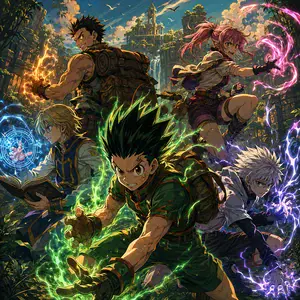 Hunter x Hunter
 Isekai
 JoJo's Bizarre Adventure
 Jujutsu Kaisen
 KonoSuba
 Made in Abyss
 Magical Girl
 Mob Psycho 100
 My Hero Academia
 Naruto
 One Piece
 One Punch Man
 Palworld
 Pokemon
 Solo Leveling